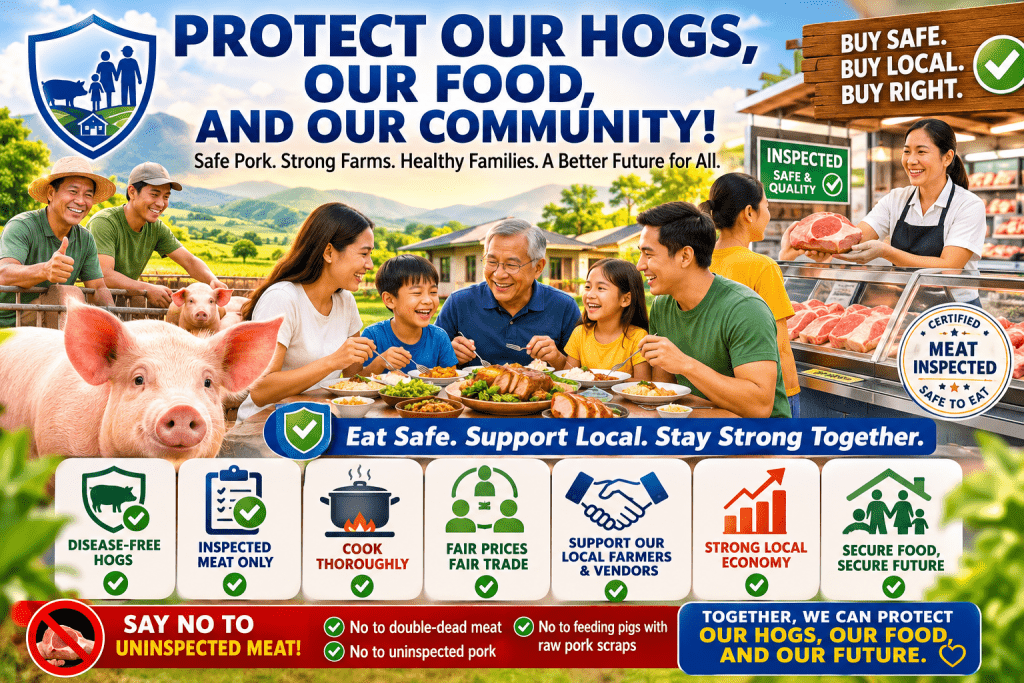
PROTECT OUR LOCAL HOGS, OUR FOOD AND OUR COMMUNITY
A Community Call for Responsible Action During African Swine Fever Outbreaks
African Swine Fever, or ASF, is a serious and often fatal viral disease of domestic and wild pigs. It does not infect people and is not transmitted to humans by eating pork. However, ASF can devastate hog populations, destroy farmers’ livelihoods, disrupt the pork supply and weaken local food security. Pork and pork products contaminated with the virus may also spread ASF when they are improperly transported, discarded or fed to pigs. (WOAH)
For this reason, our response must be based on science—not fear, misinformation or opportunism.
Consumers Should Continue Buying Safe, Inspected Pork
There is no scientific reason for consumers to completely stop eating pork solely because ASF has been detected in pigs. A sudden and unnecessary collapse in pork consumption can severely hurt responsible farmers, slaughterhouse workers, meat vendors, transporters and other families who depend on the local hog industry.
Consumers should continue purchasing pork from registered meat shops, public-market stalls and other legitimate sellers supplied by accredited slaughterhouses and inspected by authorized meat inspectors.
Pork should always be handled hygienically and cooked thoroughly. Clean hands, utensils and preparation surfaces must be used to prevent ordinary foodborne illnesses and cross-contamination.
However, cooking must never be considered a substitute for proper inspection. Meat from animals that died from disease, were illegally slaughtered or were declared unfit for human consumption must never enter the food chain.
Reject “Double-Dead” and Uninspected Meat
The community must refuse to buy or consume meat from animals that were already dead before slaughter, commonly called double-dead meat or botcha, as well as meat of unknown origin.
Although ASF itself does not make people sick, an animal that died unexpectedly may have suffered from other diseases, contamination, spoilage or improper handling. Without ante-mortem and post-mortem inspection, consumers have no reliable assurance that the meat is wholesome or fit for human consumption.
Uninspected pork can also contribute to the spread of ASF when raw meat, bones, blood, packaging, leftovers or kitchen waste are brought near farms, scavenged by pigs or fed to pigs. The ASF virus can survive in raw, frozen, dried and inadequately processed pork products for long periods. (FAOHome)
Never feed pigs with raw pork scraps, restaurant waste or untreated kitchen leftovers. Pork waste must be secured and disposed of properly so that pigs, dogs, rodents and other animals cannot scatter it.
Support Fair and Sustainable Pork Prices
Consumers naturally deserve affordable food. At the same time, prices that are forced below the reasonable cost of raising healthy pigs can destroy the local industry.
A sustainable price should be:
- Fair and affordable to consumers;
- Sufficient to cover responsible production and biosecurity costs;
- Transparent and based on proper weight and meat quality; and
- Free from manipulation, panic buying and excessive profiteering.
Consumers should be willing to pay a fair price for legally slaughtered, properly inspected and good-quality pork. Paying an unrealistically low price may appear beneficial today, but it may eventually force local farmers out of production.
When farms close, local communities lose breeders, piglets, skilled workers, feed customers, transport services and dependable sources of fresh pork. Supply then becomes more dependent on distant suppliers and large import networks. This can reduce competition, weaken community resilience and make local consumers more vulnerable to future supply disruptions and price increases.
Meat Traders and Vendors Must Protect Their Own Local Hog Supply Base
Meat vendors, viajeros and traders must avoid exploiting farmers during disease scares by offering unreasonably low live-hog prices.
Farmers should receive a fair price based on verified live weight, animal condition, market conditions and legitimate operating costs. Buyers must not take advantage of fear or emergency sales to acquire healthy animals far below sustainable value.
Destroying the local production base will ultimately harm meat vendors themselves. Without viable local farms, small vendors may lose access to dependable supplies and may be unable to compete with large businesses that have cold-storage facilities, import connections and greater purchasing power.
Vendors must also maintain complete records showing where their pork originated. They should buy only from legitimate sources and ensure that animals are slaughtered in authorized facilities and inspected by qualified personnel.
Local Government Must Enforce Inspection and Biosecurity
Local government units, veterinary offices, agriculture offices, market administrators and law-enforcement agencies must work together to:
- Ensure that all animals intended for slaughter undergo proper veterinary and meat inspection;
- Prevent the sale of illegally slaughtered and uninspected meat;
- Monitor public markets, roadside sellers, online sellers and informal distribution channels;
- Verify meat inspection certificates, transport documents and the origin of animals and pork products;
- Enforce quarantine and movement controls in accordance with official ASF zoning;
- Prevent the transport of pigs and pork from infected or restricted areas;
- Investigate unusual pig deaths immediately;
- Provide farmers with accessible testing, reporting and veterinary assistance;
- Ensure humane and sanitary disposal of infected carcasses and contaminated materials; and
- Educate communities without creating unnecessary fear of safe, inspected pork.
The National Meat Inspection Service is the country’s competent authority for meat inspection and hygiene involving both locally produced and imported meat. Effective enforcement must therefore cover slaughterhouses, transport vehicles, markets, storage facilities and other parts of the supply chain. (NMIS)
Apply Science-Based Controls to Imported and Transported Pork
Pork and pork products from ASF-affected countries or zones may present an animal-health risk when controls fail, especially when products are illegally transported, improperly declared, discarded where pigs can access them or used as pig feed.
Authorities should therefore impose strict, temporary and risk-based restrictions on pork, live pigs and pork products originating from affected areas. Border inspection, laboratory verification, traceability, quarantine and controls on passenger baggage, parcels and informal shipments must be strengthened. FAO specifically recommends intensive controls at airports, seaports, postal facilities and other entry points because contaminated pork products can transport the ASF virus. (FAOHome)
Restrictions should be based on veterinary evidence, official disease zoning and risk assessment. A blanket ban on all imported pork, regardless of origin or risk, may unnecessarily increase food prices and encourage smuggling. The objective must be to keep infected or high-risk products out—not to block legitimate, verified and disease-controlled trade without scientific justification.
Everyone Has a Responsibility
Protecting the hog industry is not the responsibility of farmers alone.
Farmers must report sickness and deaths immediately, maintain strict biosecurity and avoid secretly selling sick animals.
Consumers must buy only inspected pork and reject suspiciously cheap meat of unknown origin.
Vendors must practice honest weighing, fair pricing, traceability and responsible sourcing.
Transporters must disinfect vehicles and comply with animal movement requirements.
Restaurants and households must dispose of pork scraps securely and never provide untreated food waste to pigs.
Government authorities must enforce the law consistently while providing farmers with testing, technical assistance, compensation programs and responsible recovery or repopulation support.
Protecting Local Hogs Means Protecting Society
Failure to control ASF can result in far more than the loss of pigs. It can destroy family livelihoods, reduce local employment, weaken purchasing power, disrupt market activity and increase dependence on outside food sources.
A healthy local hog industry keeps money circulating within the community. It supports farmers, workers, feed producers, veterinarians, slaughterhouses, transporters, meat vendors, restaurants and many other small businesses.
By supporting responsible local producers, purchasing properly inspected pork, reporting illegal meat and observing strict biosecurity, we protect:
Our farmers.
Our consumers.
Our livelihoods.
Our access to fresh and safe meat.
Our local economy.
Our food security and independence.
ASF must be fought with cooperation, discipline, science and fairness—not panic.
Buy inspected pork. Reject double-dead meat. Report suspicious animal deaths. Dispose of pork waste responsibly. Support fair prices. Protect our farms.
Together, we can preserve a safe, disease-resilient and sustainable local hog industry for the entire community.
This can also be condensed into a one-page public advisory or a shorter Facebook campaign post.